More on Male Dreaminess
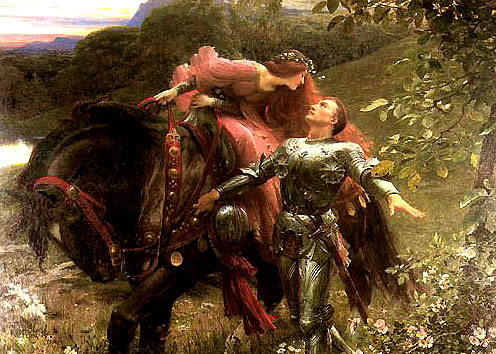
Whatever the knight in the Frank Dicksee painting is seeking, it is not (at least, it strikes me) a mate, either longterm or short, nor (as Adam Gopnik mentions in his Introduction to Alain-Fournier's The Lost Estate -- our next reading) is intercourse ever an issue.
Wagner's interest in medieval male dreaminess reaches it apex in his last work, the monumental Parsifal (1882) -- an opera about a pure, chaste male soul (Parsifal, akin to the English Arthurian myth of Galahad) whose complete freedom from sexual impulse redeems the world.
As we shall see, perhaps more clearly in our last two works, the related novels, The Lost Estate and The Great Gatsby, some men seem irrevocably drawn back to the time of their own sexual innocence and, quite possibly, to the woman (or, more likely, the image of the woman) who so loved them then.
These dreamy men of the past, oddly enough, may well be especially attractive to women readers, for reasons I will not go into here. Stay tuned . . . .
posted by MTuman @ 11:27 AM
0 comments


